The flatbed truck occupies a unique place in the road transport of heavy goods. While guides focus on categories of heavy trucks or the transport of broken-down cars, the more specific question is what makes the flatbed suitable for non-standard loads. What technical parameters truly separate the flatbed from other configurations, and in which cases is this choice imposed by default?
Flatbed, dump truck, and van: a comparison of loading capacities
The choice between a flatbed truck, a dump truck, or a van is not based solely on tonnage. The geometry of the load, its lateral accessibility, and the loading method weigh as much as the gross weight.
| Criterion | Flatbed truck | Dump truck | Van |
|---|---|---|---|
| Preferred load type | Machinery, equipment with irregular geometry | Bulk materials (rubble, soil, sand) | Palletized goods, fragile packages |
| Loading access | Lateral, rear, by crane or ramp | Rear or lateral tipping | Rear liftgate, sometimes lateral |
| Loading of non-rolling objects | Yes (auxiliary crane, slings) | Limited to dumpable materials | Limited by the dimensions of the opening |
| Weather protection | None (tarpaulin optional) | None | Complete (closed box) |
| Loading height | Variable, often low | High (dump truck edges) | Fixed, defined by the box |
This table highlights a point that general comparisons often overlook: the flatbed is the only format that accepts loads with irregular geometry without dimensional constraints related to a closed box. An aerial work platform, an industrial generator, or a welded metal structure simply does not fit into a van.
Understanding the specifics of heavy transport with flatbed trucks helps to better understand why this vehicle remains the reference as soon as the load goes beyond palletized standards.

Securing loads on flatbed trucks: often underestimated technical constraints
The open surface of the flatbed offers a freedom of loading that has a downside: each load must be secured individually according to its weight and shape. On a van, the walls help maintain the load. On a flatbed, nothing holds the goods in place during sudden braking or sharp turns.
Anchor points and securing methods
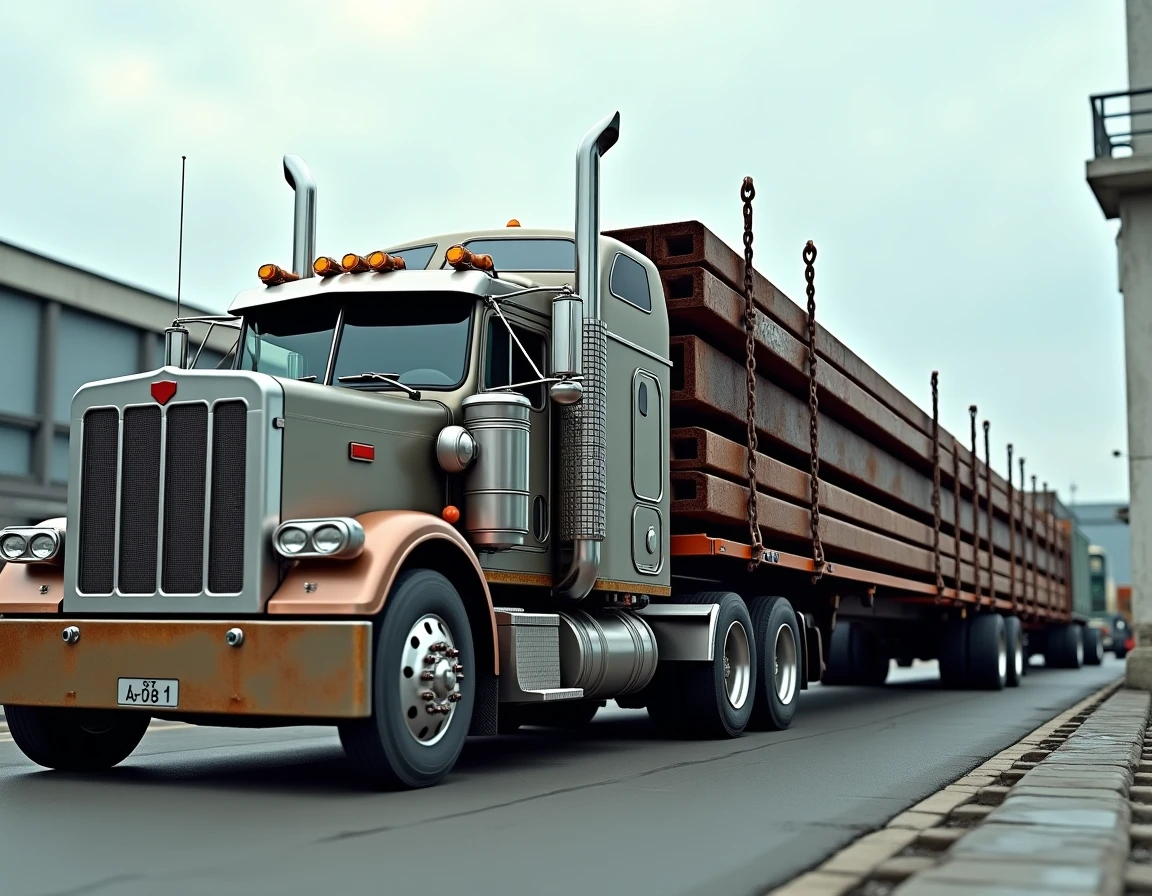
Professional flatbeds have anchor points distributed along the beams and sideboards. The choice between ratchet straps, chains, and slings depends on the unit weight of each transported piece.
- Ratchet straps are suitable for loads of moderate weight and regular surface, such as pallets of construction materials or wooden crates
- Securing chains are reserved for heavy machinery (excavators, compactors) whose weight requires a high-resistance securing device
- Textile slings protect sensitive surfaces, such as glass facade elements or painted metal parts, while ensuring a firm hold
Regulations require that the total securing force be proportional to the weight of the load. Insufficient securing engages the liability of both the transporter and the loader. This shared responsibility is a frequent blind spot: many shippers believe that securing is solely the driver’s responsibility.
Uses of flatbed trucks beyond automotive transport
Competing articles primarily associate flatbed trucks with automotive recovery. This view is reductive. The flatbed has established itself in several sectors where the load cannot be tipped, stacked, or slid into a box.
Construction machinery and agricultural equipment
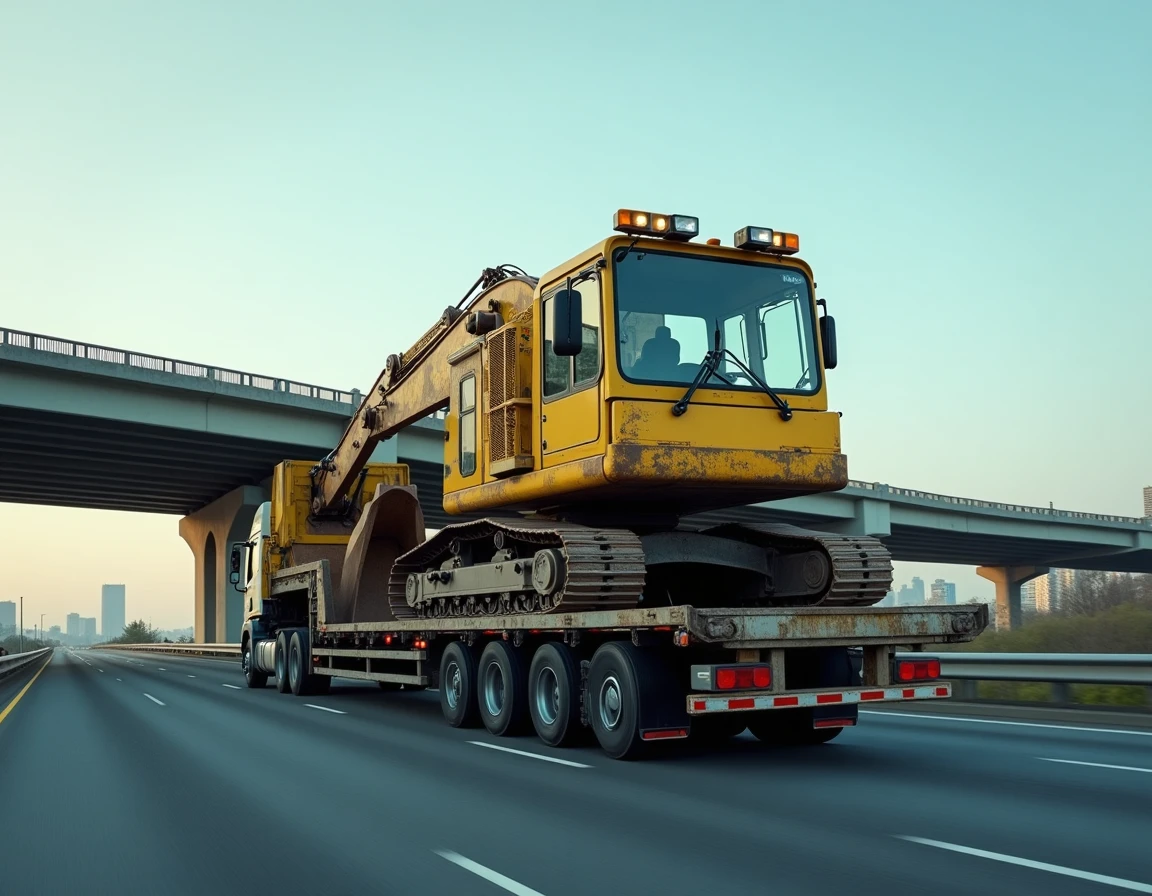
Construction machinery (mini-excavators, compact loaders) and agricultural equipment (bale presses, seeders) are loaded by ramps or cranes onto low-profile flatbeds. The low-profile flatbed reduces the overall height of the convoy, avoiding size issues under bridges and in narrow urban areas.
Event equipment and metal structures
Modular stages, grandstands, tent structures: these elements have variable lengths and widths from one project to another. The flatbed accommodates these variations without modification of the bodywork. In contrast, a van with fixed dimensions forces the load to be split or requires multiple trips.
Payload and GVWR: the thresholds that dictate the choice of flatbed
The GVWR (gross vehicle weight rating) determines both the required license and the actual capacity of the vehicle. For a flatbed truck, the payload corresponds to the GVWR minus the empty weight of the equipped vehicle (flatbed, sideboards, auxiliary crane if applicable).
A flatbed equipped with a loading crane loses several hundred kilograms of payload compared to the same bare chassis. This compromise between loading autonomy and transport capacity is rarely explained in commercial brochures.
- Light flatbeds (GVWR of 3.5 tons or less, Class B license) transport a light vehicle or small construction equipment
- Flatbed carriers (GVWR between 3.5 and 19 tons, Class C license) cover most needs for compact machinery and industrial equipment
- Tractor-semi-trailer combinations (GVWR up to 44 tons) handle heavy public works machinery and large structures
The boundary between carrier and semi-trailer is not solely defined by tonnage. The length of the flatbed also conditions the type of admissible load: a five-meter flatbed will not load a twelve-meter articulated lift when folded.
The flatbed truck remains the reference vehicle as soon as the load exceeds the standard format. Its open surface, compatibility with auxiliary cranes, and ability to accommodate variable geometries make it an irreplaceable tool in the road transport of heavy goods. The most often overlooked factor in choosing a flatbed is not tonnage, but the loss of payload associated with onboard equipment.