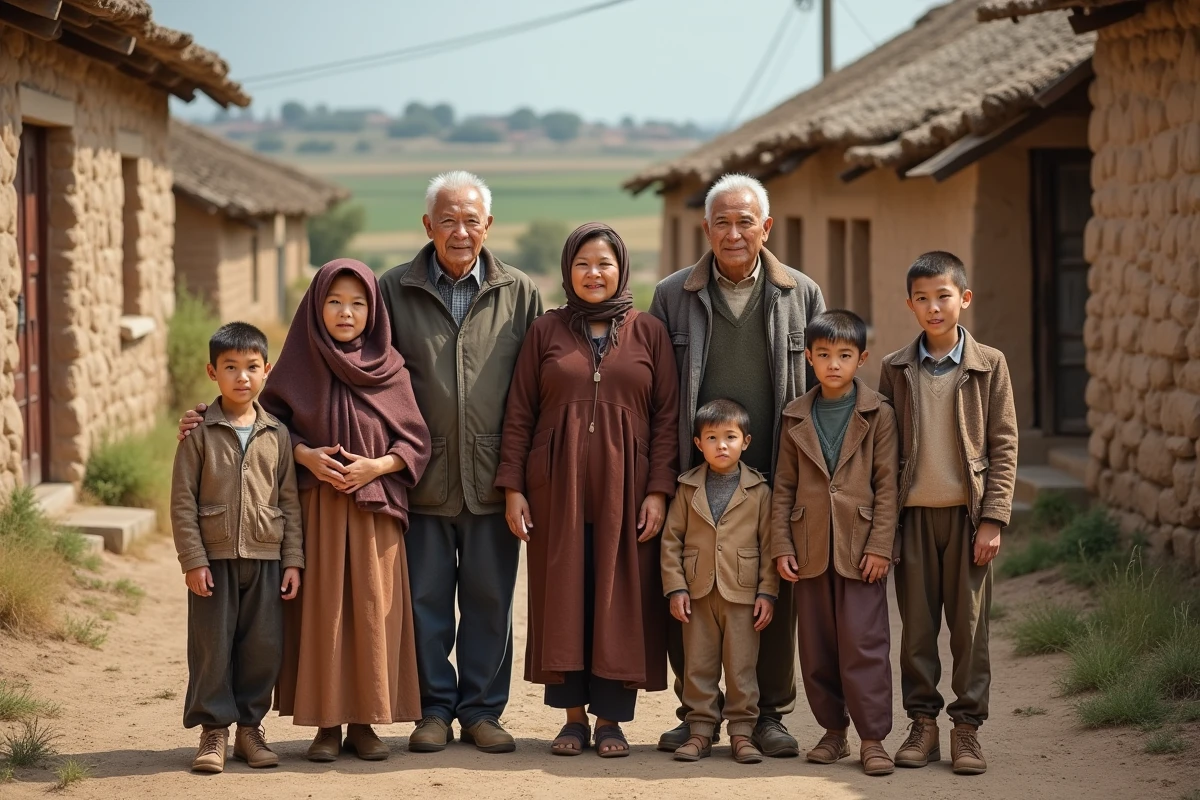
61%. This impressive rate of unions between relatives in certain regions of Pakistan is neither folklore nor a statistical accident. In Saudi Arabia, Qatar, or Dubai, the prevalence of cousin marriages confirms that here, family ties sometimes weigh much more than mere elective affinity. This reality confounds those who swear by the individual; yet it structures the lives of millions, facing the transformations of the 21st century without flinching.
In the Arabian Peninsula, the rule is simple and accepted: family first, and it starts with marriage. More than one in two Saudi couples unite two members of the same family tree. In rural Pakistan, these heights are reached or approached. Other countries, from the Emirates to Algeria, stand as bastions, maintaining record rates of consanguinity well above the global average.
This panorama, far from being fixed, is slowly redrawing itself. Demographic pressure, new laws, rising education, increasing mobility… Everything is in flux, but nothing is swept away with a wave of the hand. Migratory dynamics, confrontation with other views of marriage, and the rise of public health issues force families to adjust their references, often without severing the tenuous thread that connects them to the past.
Cousin marriage, a sometimes contested pillar
It is difficult to understand the strength of blood ties without looking back at several centuries of practices. In countless societies, marriage between relatives has long been seen as the foundation of stability. Whether to protect a heritage, to ensure alliances between clans, or to prevent the dispersion of wealth, the heart of cousin marriage beats to the rhythm of collective history rather than individual passions. Louis XIV marrying his cousin Maria Theresa shocked neither the Spanish court nor that of the Kingdom of France: it was the order of things.
Over the ages, however, consanguinity has undergone many shifts. Western societies, through numerous reforms and prohibitions, have marginalized these unions, preferring free will and individual emancipation. Medical sciences, law, and religious morality have combined to curb the custom. Notably, less than 1% of marriages in France still involve consanguinity, symbolizing a profound shift in the relationship with family.
Yet, even in 2024, the most consanguineous countries in the world perpetuate practices that are anything but artificial. Marriages between cousins are not remnants of dusty folklore, but a reasoned choice: loyalties, solidarity, transmission of values, and economic survival intertwine. Between the Maghreb, the Middle East, and South Asia, the matrimonial institution retains its adaptability without completely renouncing itself.
Behind the numbers, stories of families and traditions under tension
Consanguinity is neither a statistical curiosity nor an isolated drift: it is woven into the fabric of social relations, where tradition weighs heavily. At the heart of rural and tribal worlds, marriage between relatives secures, stabilizes, and perpetuates lineage. Here are some benchmarks: in Morocco, according to the ENSME survey (1997), the rate stands at 29.4%, reaching 33% in the south of the country. In Algeria, it ranges between 22% and 25%, Tunisia exceeds 25%, and Egypt fluctuates between 29% and 40%. Records in Mauritania (68%) and Pakistan (up to 60%) outline a precise geography.
The contrast is stark between rural and urban areas. In rural settings, the influence of the group, low mobility, and often the level of education shape this preference. For example, Béni Mellal shows 14.3% of consanguineous marriages compared to 20% in Rabat-Salé-Zemmour-Zaer. As the city gains the upper hand and cultural models diversify, the trend declines.
To better grasp the extent of the disparities, here are some notable data:
- Mauritania: 68%
- Pakistan: up to 60%
- Saudi Arabia: 51.3%
- Egypt: 29 to 40%
- Morocco: 29.4%
- France: less than 1%
In these regions, the law does not prohibit the practice; it regulates and even values it. In Morocco, for example, nearly 9% of marriages occur between first cousins, accounting for 58.46% of all recorded consanguineous marriages. In contrast, France has nearly erased this practice from public and private spaces, widening the gap with the rest of the world. It is the weight of culture, law, and tradition that shapes this invisible boundary.
Living between two worlds: new dynamics, old attachments
The influence of schools, the generalization of urbanization, and economic changes have shifted the lines, sometimes faster than one might want to admit. Families are shrinking, mobility is intensifying, pulling at the traditional model. However, in the peripheries and villages, the logic of the group and moral influence persist, defending cousin marriage as heritage and a guarantee of cohesion.
On the health front, the numbers also become warning signs. Unions between relatives favor the transmission of genetic diseases (cystic fibrosis, Down syndrome, congenital malformations). Malika, whose daughter Mouna lives with a hereditary condition after her parents’ cousin marriage, encapsulates the fears and questions of a youth torn between loyalty and the desire for emancipation. Genetic screening consultations and prevention campaigns are emerging, but the subject still clashes with taboos. Making an appointment before marriage to discuss it? That act remains rare, the words hesitant.
In large cities, encounters with other horizons change the game. Young people sometimes prefer to step outside the family circle, choosing their partners based on studies or chance. Milan, Rome, Casablanca, Cairo: consanguinity is declining, but at a pace that depends on socio-economic context, access to information, and the ability to openly discuss health issues. The tension between past and future, heritage and innovation, directs each trajectory and turns every statistic into a story in motion.
Looking at the map of consanguineous marriages worldwide is to see life paths emerge, loyalties, fractures, and hesitations. Within it, peoples tell their stories at the crossroads of history and uncertainty, sometimes torn, but never fixed. One can already sense that the next generation, in its own way, will reinvent the family tree.